I’m currently helping a family who lost a loved one in a violent crime inside their home. The house is now a crime scene and biohazard site, and no one can enter. The problem is no one knows where the will is or if one even exists.
Without an estate plan, families are left asking difficult questions. Who is legally in charge? Who can access the home? Who pays for biohazard cleanup? Who files probate? Did their loved one want burial or cremation?
Estate planning is not only about money. It prepares your family for the unexpected “what ifs” life can bring. If I can help you put a plan in place, please call. Arizona residents can start the conversation today at (480) 719-7333.
At the heart of the conflict is the question of who will ultimately control the trust. Murdoch’s eldest children, from his second marriage, have a larger stake in decision-making, which has caused friction with his younger children. Speculation is swirling about whether the trust could lead to a battle for control over the media empire when Murdoch steps down or passes away, as each family member fights for influence over key assets.
These kinds of disputes aren’t unique to high-profile families. They often arise when estate plans don’t fully account for changing family dynamics, or when there’s a lack of clarity in how assets should be distributed.
1. Clearly Defined Roles: Designate clear roles and responsibilities for family members in your estate plan to prevent future confusion or conflict.
2. Communication is Key: Open and regular communication with all stakeholders can help avoid surprises and reduce the potential for disputes.
3. Revisiting Your Estate Plan: As family circumstances and financial interests evolve, updating your estate plan is crucial to reflect those changes.
Murdoch’s situation serves as a powerful reminder that even families with significant wealth and influence are vulnerable to conflicts over inheritance. By working with an experienced estate planning attorney, you can help ensure that your legacy is passed down smoothly, with minimal family strife.
If you’d like to discuss how to protect your family from similar challenges, I’m here to help. Call me at (480) 719-7333.
]]>Their relationship ended in 1989. Peggy moved on, got married, and had children, while Jeffrey later entered a long-term relationship with Mary Lou Murray. When Jeffrey died in 2015 at the age of 59, he had no spouse or children, and the court ruled that Mary Lou Murray wasn’t entitled to his assets.
Jeffrey’s brothers, shocked to learn that Margaret was still listed as the beneficiary, have been contesting the claim in federal court. Despite their efforts, a court ruled in 2020 that Procter & Gamble should release the funds to Margaret. The money remains in limbo as the brothers continue their legal battle, but overturning the court’s decision will be challenging.
This case underscores a crucial lesson: always keep your beneficiary forms up to date. These forms, which designate who receives assets from retirement accounts and life insurance policies, can take precedence over wills and other estate planning documents. Federal law typically mandates that employers distribute these funds to the last named beneficiary or a surviving spouse unless the spouse waives the claim.
Regularly reviewing and updating beneficiary designations can prevent unintended outcomes and ensure your assets are distributed according to your wishes. If you need assistance with estate planning or updating your beneficiary forms, don’t hesitate to reach out to me at (480) 719-7333. It’s a small step that can make a big difference for your loved ones.
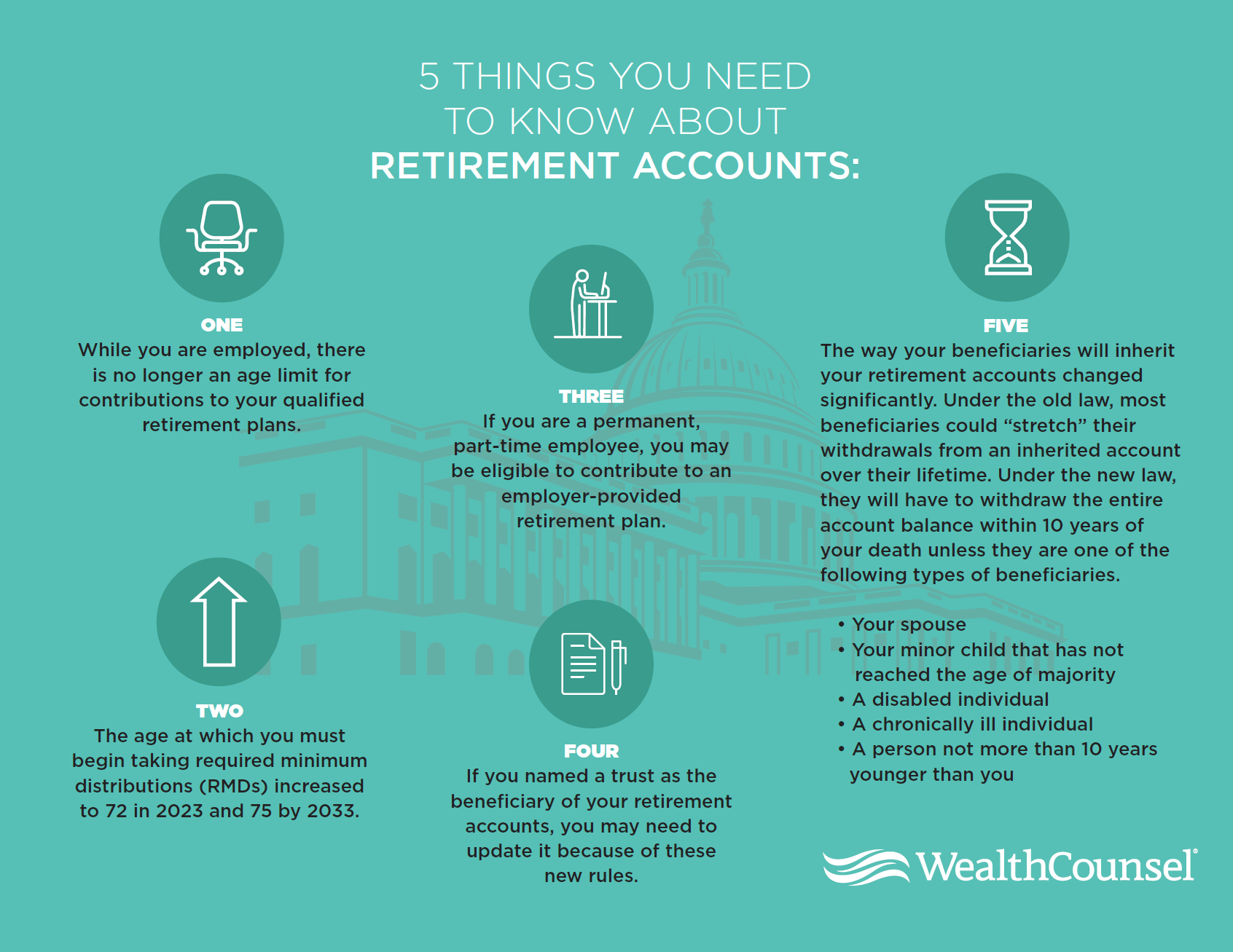
]]>On December 29, 2022, President Biden signed the Setting Every Community Up for Retirement Enhancement 2.0 Act (SECURE 2.0 Act). The previous SECURE Act in 2020 made several changes to retirement planning:
The SECURE Act provided a few exceptions to the mandatory 10-year withdrawal rule with a list of eligible designated beneficiaries:
The SECURE 2.0 Act made quite a few enhancements to clarify the original legislation. Several of the key enhancements are summarized below:
The SECURE 2.0 Act allows exceptions to the 10 percent early distribution excise tax, including the following:
The new provisions and exceptions in the SECURE 2.0 Act may change the decisions you have made for your intended beneficiaries and alter the path to achieving your long-term goals.
Under the old law, beneficiaries of inherited retirement accounts could take distributions over their individual life expectancy. Under the SECURE Act and SECURE 2.0 Act, the shorter 10-year time frame for taking distributions will accelerate income tax due, possibly bumping your beneficiaries into a higher income tax bracket and causing them to receive less of the funds in the retirement account than you may have originally anticipated. Eligible designated beneficiaries exempt from the 10-year rule may still have the opportunity to benefit from future retirement plan growth.
Your estate planning goals likely include more than just tax considerations. You may also be concerned with protecting a beneficiary’s inheritance from their creditors, future lawsuits, and a divorcing spouse. In order to protect your hard-earned retirement account and the ones you love, it is critical to act now.
We may have addressed the distribution of your retirement accounts in your living trust, or we may have created a retirement trust that would handle your retirement accounts at your death. Your trust may have included a conduit provision, which requires that retirement distributions be immediately distributed to or for the benefit of the beneficiaries (rather than being held in trust). With the SECURE Act’s passage, a conduit trust structure may not be the best choice any longer because the trustee will be required to distribute the entire retirement account balance to most types of beneficiary within 10 years of your death (which, as discussed above, can create an income tax headache for the beneficiary).
Under the current rules, if a person dies prior to their required beginning date for RMDs, then designated beneficiaries will not be required to take out RMDs during the 10-year payout period (but would need to take full distribution by the end of the 10-year payout period). However, if the person died after their required beginning date, the beneficiary must continue to take out RMDs on an annual basis (with full distribution at the end of the 10-year payout period).[1] We should discuss the benefits of an accumulation trust, an alternative trust structure through which the trustee can take any required distributions and continue to hold them in a protected trust for your beneficiaries.
For most Americans, a retirement account is the largest asset they will own when they pass away. If we have not done so already, it may be beneficial to create a trust to handle your retirement accounts. While many accounts offer simple beneficiary designation forms that allow you to name an individual or charity to receive funds when you pass away, this form alone does not take into consideration your estate planning goals and the unique circumstances of your beneficiary. A trust is a great tool to address the mandatory 10-year withdrawal rule under the SECURE Act, providing continued protection of a beneficiary’s inheritance.
If you have beneficiaries with a disability or chronic illness, you may want to consider a special needs or supplemental needs trust. Beneficiaries are exempt from the mandatory 10-year payout rule, giving them more time for the retirement account to grow tax-deferred.
With the changes to the laws pertaining to retirement accounts, now is a great time to review and confirm your retirement account information. Whichever estate planning strategy is appropriate for you, it is important that your beneficiary designation is filled out correctly. If your intention is for the retirement account to go into a trust for a beneficiary, the trust must be properly named as the primary beneficiary. If you want the primary beneficiary to be an individual, they must be named on a beneficiary designation form. You should ensure that you have listed contingent beneficiaries as well.
If you have recently divorced or married, you will need to ensure that the appropriate changes are made to your current beneficiary designations. At your death, in many cases, the plan administrator will distribute the account funds to the beneficiary listed, regardless of your relationship with the beneficiary or what your ultimate wishes might have been.
Although these new laws may be changing the way we think about retirement accounts, we are here and are prepared to help you properly plan for your family and protect your hard-earned retirement accounts. If you are charitably inclined, now may be the perfect time to review your planning and possibly use your retirement account to fulfill your charitable desires.
A charitable remainder trust can use annuity and unitrust payments to mimic the “stretch” provided by using life expectancy. Assets are funded into the trust and then liquidated or sold by the trust. The money from the sale is then invested to produce a stream of income. The sale avoids capital gains tax at the trust level because the trust is liquidating the account and is tax-exempt. However, the noncharitable recipient of the income stream will still be responsible for income tax on the distributions. In contrast, you may distribute your entire retirement asset directly to a charity, and they will not have to pay tax on the income from the plan. Additionally, If you have a significant estate, there may be an estate tax charitable deduction.
Following the recent changes to the SECURE Act, you may be concerned about the amount of money that will be available to your beneficiaries following your death and the impact that the potential accelerated income tax may have on that ultimate amount. We can explore different strategies with your financial and tax advisors to infuse your estate with additional cash upon your death. Give us a call today to schedule an appointment to discuss how your estate plan and retirement accounts might be impacted by the SECURE Act and SECURE 2.0 Act. (Kierman one-sheet guide)
[1] Different distribution rules may apply to different types of beneficiaries, and eligible designated beneficiaries may be subject to different rules.
]]>You can make changes to your estate plan when you are still alive, but when you pass away, your plan is effectively—but not entirely—set in stone. Incorporating milestones into your estate plan is one way to hedge against the unpredictable future. By creating incentives for particular events, you can continue to exercise your values and provide for your loved ones beyond your lifetime.
If-then statements allow outcomes to be determined with conditions. They are found in deductive logic, computer programming, and legal documents, including estate planning documents.
The premise of an if-then statement is simple: if a given criteria is met, then a certain action follows. For example, you might write in your will that, “If my spouse predeceases me, then I leave my house to my oldest son,” or, “If both my spouse and I pass away, then [Person X] will be nominated as guardian of our children.”
Such clauses can help you retain some power over outcomes that would otherwise be out of your control. They can also help you to plan for future contingencies in a way that is not possible with simple declarative statements (e.g., “I leave my house to my spouse.”).
If-then clauses can be combined to account for numerous future possibilities. So, in addition to “If my spouse predeceases me, then I leave my house to my oldest son,” you could specify that “If my son is not employed, then I put my home in a trust to be managed by [Trustee Y].”
Conditional provisions that offer enhanced flexibility to your estate plan can take many forms. These provisions do not always have to be if-then statements. They can also include gifts or distributions that are triggered at specific times or milestones.
The following are some events that you might consider incorporating into your estate plan:
Keep in mind that these estate planning milestones can be combined and modified as you wish. For example, you might give wedding money to a child, but keep the rest of their inheritance in a trust so that if your child gets divorced, the money and property you pass on will not end up in the hands of their ex-spouse.
Another option is to set up your estate plan to direct more money to someone if the value of a certain account or property rises. Or, if the account overperforms, the increase in value could be donated to a charity of your choice. You could also use an if-then statement to provide that a beneficiary receives an extra gift only if they meet a certain milestone. The options are nearly endless.
Populating your estate documents with numerous if-then clauses and milestones can make things more complicated. But it might give you greater peace of mind knowing that numerous potentialities have been anticipated.
It is crucial to make sure that everything is in writing. Your estate planning attorney can create a diagram or flowchart that helps you keep track of all the moving pieces. Having a chart—rather than a jargon-filled legal document—can make it easier to review and update your estate plan if there is a major life event, such as a death, birth, marriage, or illness).
Whatever you decide to do, do not put it off. Act now to create a plan that provides for your loved ones while honoring your wishes. Schedule an appointment with our estate planning attorneys to get started.
[1] Kim Forrest, Who Pays for the Wedding? Here’s the Official Answer, WeddingWire (May 21, 2021), https://www.weddingwire.com/wedding-ideas/who-pays-for-what-in-a-wedding.
[2] Sean Dennison, 64% of Americans Aren’t Prepared for Retirement—and 48% Don’t Care, Yahoo (Sept. 23, 2019), https://www.yahoo.com/now/survey-finds-42-americans-retire-100701878.html.
]]>