When it comes to estate planning for high-net-worth individuals, private annuities can be a game-changer. This lesser-known strategy offers a unique way to transfer wealth while minimizing estate taxes, providing financial security for the annuitant, and potentially preserving family wealth for future generations.
A private annuity is an agreement where an individual (the annuitant) transfers assets to another party, typically a family member, in exchange for a lifetime stream of income. Unlike commercial annuities sold by insurance companies, private annuities are established privately between individuals or entities.
1. Estate Tax Reduction: Assets transferred via a private annuity are removed from the annuitant’s taxable estate. This can significantly reduce estate tax liabilities, especially for estates over the federal exemption limit.
2. Income Stream for Life: The annuitant receives guaranteed payments for life, providing financial stability. Payments are typically structured to ensure that the transferor has sufficient cash flow in retirement.
3. Wealth Transfer Efficiency: The appreciation of the transferred asset’s value occurs outside the annuitant’s estate, allowing heirs to benefit from the growth tax-free.
4. Flexibility: Private annuities are customizable to meet the annuitant’s financial goals and family dynamics.
Who Should Consider Private Annuities?
🔹 Business Owners transitioning their business to the next generation.
🔹 Real Estate Investors who want to unlock liquidity without triggering large capital gains immediately.
🔹 High-Net-Worth Families seeking to reduce estate taxes while ensuring a predictable income stream.
Risks and Considerations:
🔹 Longevity Risk: If the annuitant lives longer than expected, the beneficiary may pay more than the transferred asset’s value.
🔹 Payment Risk: The beneficiary must have the financial capacity to make payments over the annuitant’s lifetime.
🔹 Tax Implications: There are upfront and ongoing tax considerations, including potential gift taxes, capital gains, and income taxes.
If you’re looking to preserve your legacy, reduce your tax burden, and secure your financial future, a private annuity might be worth exploring. Whether you’re a business owner, real estate investor, or family member seeking strategic estate planning advice, I am here to help. If you are in Arizona, let’s start that conversation today. Call (480) 719-7333.
]]>One of the biggest mistakes is assuming a “common law” spouse is recognized when it comes to inheritance tax. The reality is, unless you are legally married or in a civil partnership, your partner will not inherit assets tax-free. This misconception can leave families shocked at tax bills that could have been avoided with proper planning.
Another issue is giving away too much too soon. It may feel generous to hand over property or cash early, but doing so without considering your own retirement or possible care needs can backfire. A gift made today might mean financial hardship tomorrow. It is about striking the right balance between generosity and security.
There are also risks tied to how gifts are structured. Imagine giving a large asset to a child who later goes through a divorce. Without legal protections like pre-nup or post-nup agreements, those assets can be lost. Lifetime gifting needs to be supported with legal safeguards that match your family’s circumstances.
Then there is the matter of “retaining benefit.” If you give away a holiday home but continue to use it, the value is still included in your estate for inheritance tax. In simple terms, the law views that as still being yours. That means it could face a 40 percent tax upon your passing.
Constance Carter, a real estate leader and author, put it powerfully: Estate planning is survival and power. She reminds us that families, especially those historically shut out of wealth-building opportunities, cannot afford to leave assets unprotected. Since most wealth in America transfers through real estate, failing to plan means losing hard-earned progress.
The lesson is clear. Estate planning is not just about paper work; it is about ensuring stability for the next generation. By setting up wills, trusts, and the right legal strategies, you create a shield around what you have worked for. Do not leave your family vulnerable to taxes, court battles, or financial loss.
If you are ready to explore your options, visit Kierman Law. Their guidance can help you avoid these mistakes and make sure your legacy is protected the way you intend.
]]>The federal estate tax exemption is the amount below which your estate will not be subject to taxes when you die. This amount will go up again for 2025, as it is adjusted annually for inflation. For people who pass away in 2025, the exemption amount will be $13.99 million (it is $13.61 million in 2024). A married couple will have a combined exemption for 2025 of $27.98 million ($27.22 million for 2024).
In 2025, the annual gift tax exclusion will be $19,000. This means you can give up to $19,000 to as many individuals as you want without having to pay gift taxes. But what if you want to give someone $30,000 without paying taxes? You may elect to use your lifetime gift tax exemption to cover that additional $11,000. However, using your lifetime gift tax exemption will typically reduce your estate tax exemption.
Do you have questions about coordinating your estate plan with your IRS tax exclusions? You can schedule an appointment with me by calling (480) 719-7333.
You should consider communicating the following information to your family to ensure that your loved ones understand and will be prepared to carry out your wishes during a difficult time:
If you need help with any of these steps, I am here to help. I can assist you with determining your wealth transfer goals, creating a plan to achieve these goals, and effectively communicating this information to your loved ones. You can reach me at (480) 719-7333.
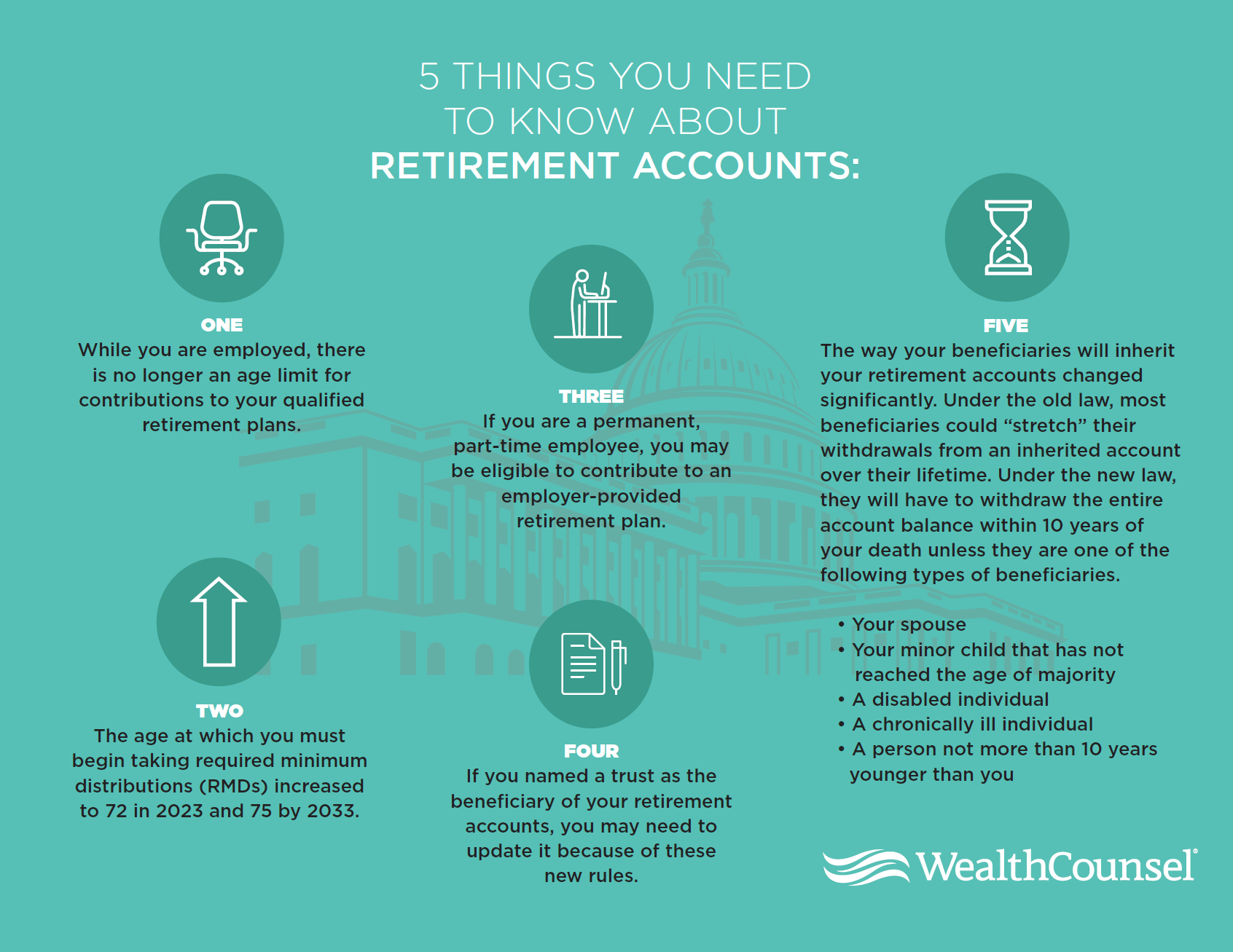
]]>On December 29, 2022, President Biden signed the Setting Every Community Up for Retirement Enhancement 2.0 Act (SECURE 2.0 Act). The previous SECURE Act in 2020 made several changes to retirement planning:
The SECURE Act provided a few exceptions to the mandatory 10-year withdrawal rule with a list of eligible designated beneficiaries:
The SECURE 2.0 Act made quite a few enhancements to clarify the original legislation. Several of the key enhancements are summarized below:
The SECURE 2.0 Act allows exceptions to the 10 percent early distribution excise tax, including the following:
The new provisions and exceptions in the SECURE 2.0 Act may change the decisions you have made for your intended beneficiaries and alter the path to achieving your long-term goals.
Under the old law, beneficiaries of inherited retirement accounts could take distributions over their individual life expectancy. Under the SECURE Act and SECURE 2.0 Act, the shorter 10-year time frame for taking distributions will accelerate income tax due, possibly bumping your beneficiaries into a higher income tax bracket and causing them to receive less of the funds in the retirement account than you may have originally anticipated. Eligible designated beneficiaries exempt from the 10-year rule may still have the opportunity to benefit from future retirement plan growth.
Your estate planning goals likely include more than just tax considerations. You may also be concerned with protecting a beneficiary’s inheritance from their creditors, future lawsuits, and a divorcing spouse. In order to protect your hard-earned retirement account and the ones you love, it is critical to act now.
We may have addressed the distribution of your retirement accounts in your living trust, or we may have created a retirement trust that would handle your retirement accounts at your death. Your trust may have included a conduit provision, which requires that retirement distributions be immediately distributed to or for the benefit of the beneficiaries (rather than being held in trust). With the SECURE Act’s passage, a conduit trust structure may not be the best choice any longer because the trustee will be required to distribute the entire retirement account balance to most types of beneficiary within 10 years of your death (which, as discussed above, can create an income tax headache for the beneficiary).
Under the current rules, if a person dies prior to their required beginning date for RMDs, then designated beneficiaries will not be required to take out RMDs during the 10-year payout period (but would need to take full distribution by the end of the 10-year payout period). However, if the person died after their required beginning date, the beneficiary must continue to take out RMDs on an annual basis (with full distribution at the end of the 10-year payout period).[1] We should discuss the benefits of an accumulation trust, an alternative trust structure through which the trustee can take any required distributions and continue to hold them in a protected trust for your beneficiaries.
For most Americans, a retirement account is the largest asset they will own when they pass away. If we have not done so already, it may be beneficial to create a trust to handle your retirement accounts. While many accounts offer simple beneficiary designation forms that allow you to name an individual or charity to receive funds when you pass away, this form alone does not take into consideration your estate planning goals and the unique circumstances of your beneficiary. A trust is a great tool to address the mandatory 10-year withdrawal rule under the SECURE Act, providing continued protection of a beneficiary’s inheritance.
If you have beneficiaries with a disability or chronic illness, you may want to consider a special needs or supplemental needs trust. Beneficiaries are exempt from the mandatory 10-year payout rule, giving them more time for the retirement account to grow tax-deferred.
With the changes to the laws pertaining to retirement accounts, now is a great time to review and confirm your retirement account information. Whichever estate planning strategy is appropriate for you, it is important that your beneficiary designation is filled out correctly. If your intention is for the retirement account to go into a trust for a beneficiary, the trust must be properly named as the primary beneficiary. If you want the primary beneficiary to be an individual, they must be named on a beneficiary designation form. You should ensure that you have listed contingent beneficiaries as well.
If you have recently divorced or married, you will need to ensure that the appropriate changes are made to your current beneficiary designations. At your death, in many cases, the plan administrator will distribute the account funds to the beneficiary listed, regardless of your relationship with the beneficiary or what your ultimate wishes might have been.
Although these new laws may be changing the way we think about retirement accounts, we are here and are prepared to help you properly plan for your family and protect your hard-earned retirement accounts. If you are charitably inclined, now may be the perfect time to review your planning and possibly use your retirement account to fulfill your charitable desires.
A charitable remainder trust can use annuity and unitrust payments to mimic the “stretch” provided by using life expectancy. Assets are funded into the trust and then liquidated or sold by the trust. The money from the sale is then invested to produce a stream of income. The sale avoids capital gains tax at the trust level because the trust is liquidating the account and is tax-exempt. However, the noncharitable recipient of the income stream will still be responsible for income tax on the distributions. In contrast, you may distribute your entire retirement asset directly to a charity, and they will not have to pay tax on the income from the plan. Additionally, If you have a significant estate, there may be an estate tax charitable deduction.
Following the recent changes to the SECURE Act, you may be concerned about the amount of money that will be available to your beneficiaries following your death and the impact that the potential accelerated income tax may have on that ultimate amount. We can explore different strategies with your financial and tax advisors to infuse your estate with additional cash upon your death. Give us a call today to schedule an appointment to discuss how your estate plan and retirement accounts might be impacted by the SECURE Act and SECURE 2.0 Act. (Kierman one-sheet guide)
[1] Different distribution rules may apply to different types of beneficiaries, and eligible designated beneficiaries may be subject to different rules.
]]>The IRS has revised the estate tax exemption limits for the year 2023. Individuals and families can now pass on a larger portion of their wealth without incurring federal estate taxes. For 2023, the estate tax exemption has been raised to [current exemption amount], up from [previous exemption amount], representing a substantial increase. This change can significantly impact estate planning strategies, offering greater flexibility to high-net-worth individuals and families.
One noteworthy feature that remains unchanged is the portability of the unused estate tax exemption between spouses. This means that if one spouse passes away and does not use their entire exemption, the unused portion can be transferred to the surviving spouse. This provision can be immensely beneficial in maximizing the estate tax savings for couples, allowing the surviving spouse to potentially utilize both their own and their deceased spouse’s unused exemptions.
With the increased exemption limit, gifting strategies have gained renewed significance. Individuals and families can consider making larger lifetime gifts to heirs and beneficiaries without triggering gift taxes. Leveraging annual gift exclusions, which allow tax-free gifting up to a certain amount per recipient, becomes even more advantageous given the higher exemption threshold.
Moreover, the concept of “gift splitting” remains a viable option for married couples. This strategy enables spouses to combine their individual gift exclusions and jointly gift substantial assets to beneficiaries. However, it’s important to note that these gifting strategies must be approached thoughtfully, as they may affect the step-up in basis for capital gains tax purposes.
The substantial increase in the estate tax exemption underscores the importance of reviewing and updating existing estate plans. Estate attorneys should encourage clients to revisit their wills, trusts, and other planning documents to ensure they align with the new exemption limits and overall financial goals. Provisions that were strategically designed based on previous exemption amounts may no longer be optimal in the current landscape.
Additionally, clients should evaluate the impact of these changes on their beneficiary designations, charitable giving plans, and business succession strategies. For instance, philanthropically inclined individuals may want to explore advanced techniques like charitable remainder trusts or donor-advised funds to optimize their giving while minimizing taxes.
Conclusion
The IRS’s 2023 changes to estate tax exemptions offer a unique opportunity for estate attorneys and their clients to optimize their estate plans for greater tax efficiency and wealth preservation. By understanding the revised exemption limits, staying informed about gifting strategies, and reviewing existing plans, individuals and families can make informed decisions that align with their financial objectives. Contact us to collaborate with an experienced estate attorney to navigate these changes successfully and ensure a secure financial future for loved ones.
]]>You are your own boss, and you have your own business. That means it is your responsibility to obtain the important things we associate with employment, such as retirement accounts and insurance. To properly plan for your financial future and the future of your business and loved ones, it is important to have a comprehensive plan and an experienced advisor team. The right advisor team can educate you about the available retirement plan options and the best investment strategies based on your unique situation. You can also discuss the different types of insurance you may need to protect the important aspects of your life, such as disability, life, and business insurance. An experienced advisor team can help you determine how much insurance you need to ensure that you and your loved ones are protected no matter what, as well as how best to protect what you have worked so hard for.
As a self-employed individual, your business activities are likely to support most if not all of your financial needs. It is important that these activities are protected to ensure that you can support yourself and your loved ones no matter the circumstances. By working with an experienced planning team, we can address some important considerations that may be keeping you up at night:
Everything in life comes with a certain amount of risk—being self-employed is no different. From a business standpoint, a self-employed person may be personally susceptible to the business’s creditors or other lawsuits involving the business’s activities. As an individual, you may also be concerned about personal creditor claims, potential divorces, and other lawsuits. Although we cannot eliminate all risks, we can take steps to help minimize them. With respect to the business, it is important for you to work with an experienced attorney and tax preparer to ensure that the business is formed or organized in a way that limits liability for some of the potential risks. Personally, you can take the first steps toward protecting yourself and your business by adequately insuring both. If you are concerned about protecting what you leave behind to your loved ones, there are special types of trusts that can be used to help ensure that your loved ones can benefit from their inheritance while minimizing the likelihood that it will be taken and used for a different purpose.
We understand that you have a lot on your plate. Let us take part of the burden off of your shoulders by crafting a plan that is unique to your personal circumstances. Give us a call so we can schedule your first meeting and get you on the path to a protected future for you, your business endeavors, and your loved ones.
]]>According to the Social Security Administration, “Social Security will replace about 40% of your annual pre-retirement earnings.” Thus, you need to have a plan if you wish to maintain your lifestyle once you are no longer working.
As a self-employed individual, you are responsible for finding the right retirement plan since you do not have an employer that has selected one for you. Working with an experienced planning team means that you can find the right investment tools for your future and ensure that they are properly funded and protected regardless of what your life may look like.
Additionally, it is important that you have a plan for what happens if there are any funds left in your retirement or investment accounts. What you leave behind for your loved ones needs to be properly protected. An experienced planning team can ensure that your loved ones are provided for in the most beneficial way.
Depending on the nature of your business, you may have some options when you either no longer want to work or are no longer able to work. Maybe you will be able to sell some part of your business to an employee or competitor. This would supply you with cash to fund your retirement or provide for your family upon your passing. However, in order for this to happen, your business has to have something to sell.
If you are an independent contractor providing services, you may not have anything that can be sold when you are done working. If this is your situation, it is important that you are setting aside money to provide for your and your loved ones’ futures.
To ensure that you are properly protected, there are several different advisors you should consider employing to help you plan for your future. First, you should work with a financial advisor who can walk you through what you currently own, help you articulate your future financial goals, and craft a plan to get there. You should also work with a reputable insurance agent to ensure that both you and your business have the proper insurance. You should consider a variety of insurance options, such as disability insurance to provide income when you are unable to work, life insurance so you can financially support your loved ones after you have passed away, and maybe an umbrella policy to help protect you from any risks that you may be undertaking in operating your business. Next, it is important that you work with the right tax professional to ensure that you are reporting your business and personal income appropriately and availing yourself of the available tax credits and deductions. Additionally, an experienced business law attorney can advise you on the best way to operate your business and help provide you with maximum asset and liability protection. Lastly, an experienced estate planning attorney can help you control what will happen to you, your money, and your property while you are alive but unable to make your own decisions and to your money and property at your death, as well as make arrangements for any dependents you may have. Without a proper plan in place, these decisions will be made by a judge in accordance with state law, which may result in decisions you would not have agreed with.
Ready to take the next step in securing your future? Contact Kierman Law today to schedule a consultation. Our team is here to answer your questions and guide you through the estate planning process, ensuring your unique needs as a self-employed individual are met with expertise and care. Don’t wait—protect your legacy and gain peace of mind by reaching out to us now.
]]>